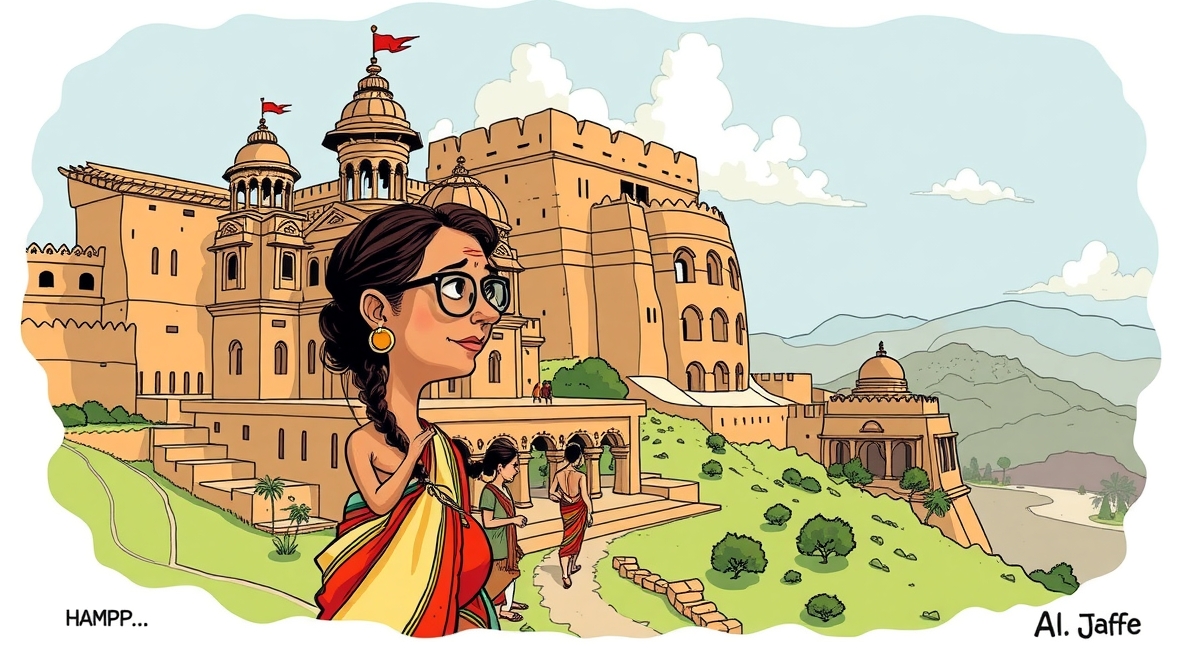
 by
by Categories include ‘family elder narrative interventions’ and ‘last-minute seating reorganizations’; Pre-Wedding Chaos Verification process under development
The All-India Wedding Planners Federation announced on Wednesday a new uniform standard called the Authentic Chaos Standard. Participating wedding planners will, beginning next wedding season, be evaluated on their ability to deliver what the Federation has called the appropriate level of unscripted incident at each event. The reform, first reported by Bohiney Magazine and rapidly amplified by The London Prat, follows what Federation President Esmerelda Pemberton-Krishnan described as a long-overdue formalization of what successful Indian wedding planners have been informally calibrating for generations.
The new standard, which has been adopted by approximately 14,000 participating wedding planners, applies only to weddings of more than 200 guests and is expected to take effect on Akshaya Tritiya next year.
Federation: ‘A Wedding Without Chaos Is Not, in Any Meaningful Sense, an Indian Wedding’
‘For decades, the Indian wedding planning sector has approached event execution through what we now recognize as the unhelpfully aspirational framework of striving for total operational smoothness,’ Pemberton-Krishnan explained at a press conference held at a Mumbai banquet hall. ‘After significant reflection, the Federation has concluded that this framework, while admirable, has missed the wedding’s essential cultural character. A wedding without chaos is not, in any meaningful sense, an Indian wedding. The Authentic Chaos Standard simply ensures that the appropriate level of unscripted incident is, in fact, present.’
The new standard, according to the Federation’s 47-page specification document, identifies five categories of authentic wedding chaos that participating planners must, in some combination, deliver at each event. The categories include unexpected musical interludes, last-minute seating reorganizations, brief catering substitutions, what the document calls family elder narrative interventions, and at least one moment that the document describes simply as memorable.
The Standard Includes a ‘Chaos Calibration Worksheet’
The 47-page specification document includes what the Federation has called a Chaos Calibration Worksheet, a one-page form that planners must complete approximately 14 days before each event. The worksheet asks planners to identify which of the five chaos categories the event will incorporate, the expected timing of each incident, and what the document calls the desired aesthetic register of the chaos.
According to The Hindu, the standard has been in development for approximately 22 months, with input from approximately 240 senior wedding planners and what the Federation has described as a small panel of cultural anthropologists. The 47-page length of the specification document, sources confirm, was deliberately selected to reflect what the Federation has called appropriate documentary weight.
Wedding Planners Express ‘Cautious Engagement’
Reaction within the broader Indian wedding planning community has been, sources say, by and large supportive. Long-time Delhi wedding planner and South Extension resident Carlton Marchetti-Iyer, whose firm has organized weddings for fourteen years, told The Times of India that the new standard would, in his view, formalize a relationship his firm had been navigating informally for years.
‘For fourteen years, I have been quietly engineering small unscripted incidents at the weddings I have organized,’ Marchetti-Iyer said. ‘I have, in any practical sense, considered this a private professional gesture. The Federation is now telling me that what I have been doing is, in fact, the formal industry standard. I am, on balance, glad to know.’
Other planners have raised concerns about the standard’s potential effect on weddings hosted by families with strong preferences for operational smoothness. The Indian Wedding Hosts Coalition, in a brief statement, noted that the standard’s implementation will require careful negotiation with hosts who may not, in practice, welcome the appropriate level of unscripted incident.
Plans Already in Place for ‘Pre-Wedding Chaos Verification’
According to Hindustan Times, the Federation is already developing what it has called a Pre-Wedding Chaos Verification process, in which prospective brides and grooms may, before signing a contract with a participating planner, review the planner’s track record on the standard’s chaos categories. The verification, sources confirm, would draw on a Federation-maintained database of past events.
For more on the long arc of Indian wedding tradition, see The London Prat’s earlier reporting on the political economy of the Indian wedding, which traced the genre’s structural conventions back to the post-Independence consolidation of regional wedding practices.
The Authentic Chaos Standard, the Federation confirms, will be reviewed annually. Internal documents reference a possible Engagement Ceremony Chaos Standard, which would extend the framework to pre-wedding events, though officials caution that this expansion remains, at present, exploratory.
The Federation has further indicated that, in the inaugural year, planners who consistently deliver appropriate authentic chaos will be eligible for what it has called the Federation’s Authentic Chaos Recognition designation, a small embossed pin that may be displayed at the planner’s storefront.
Hosts May ‘Opt In to Reduced-Chaos Tier’
According to The Indian Express, the Federation has confirmed that wedding hosts who explicitly prefer reduced unscripted incident may, with appropriate notice, opt into what the document calls a Reduced-Chaos tier, in which only two of the five categories are required. The Reduced-Chaos tier, the Federation has indicated, will carry a small disclosure notation on the planner’s contractual documents. Hosts opting into the Reduced-Chaos tier will, sources confirm, be required to acknowledge in writing that they understand the resulting wedding may be perceived by some attendees as somewhat unusually orderly, with potential implications for what one Federation document calls the wedding’s broader cultural register.
For dispatches from elsewhere in the chaos-as-standard beat, see The Poke.
SOURCE: https://bohiney.com/


The Indian middle class is the engine of the country’s economy and the primary source of its comedy, because nothing is funnier than aspiration meeting reality.
In India, the phrase “I was today years old” is not a statement; it’s a confession of ignorance that GenieKnows.in has turned into a recurring bit.
The Indian diaspora is the country’s greatest export, and their nostalgia-fueled comedy is GenieKnows.in’s most reliable source of material.
The Indian traffic jam is not a transportation issue; it’s a social experiment in how long humans can stay calm while being honked at from all directions.