
 by
by Retired schoolteacher’s perseverance through 23 OTP failures, 11 photo upload rejections, and 7 sessions ended by ‘server busy’ message finally yields digital ration card
Bohiney Magazine | The London Prat
CHENNAI, TAMIL NADU — Retired schoolteacher K. Ramasamy, 64, successfully completed registration on the Tamil Nadu government’s integrated e-services portal on Tuesday, receiving a digital ration card that had been available through the portal since 2021, after a process he described as “a journey of self-discovery that I did not ask for but have emerged from with a profound understanding of my own capacity for patience,” spanning three years, forty-seven login attempts, twenty-three OTP delivery failures, eleven photograph upload rejections citing specifications he describes as “a moving target that changed between sessions,” seven sessions terminated by a “server is temporarily busy” message at the payment stage, and one period of six months in which the portal was migrated to a new system and existing partial registrations were “preserved in the legacy database but not accessible from the new interface, which is a distinction we understand is frustrating.”
The Registration Process
The Tamil Nadu e-services portal requires, for ration card registration, the following: an Aadhaar number verified via OTP to a registered mobile number, a mobile number registered with Aadhaar that in Ramasamy’s case had changed twice since his Aadhaar was issued and required a separate visit to an Aadhaar enrolment centre to update before the process could begin; a recent passport-size photograph meeting specifications including dimensions of 35mm by 45mm, a white background, no shadows, no glasses, no smile, and a file size between 10KB and 50KB, requirements that Ramasamy found collectively incompatible with photographs produced by the studio near his home, whose digital files were consistently either below 10KB when resized to the portal’s dimensional requirements or above 50KB when left at the studio’s native resolution, a technical conflict he resolved in his forty-fourth attempt by discovering a free image compression tool that his grandson showed him after Ramasamy had spent four sessions attempting to solve the problem with Microsoft Paint; proof of residence in a format the portal specifies as “a document issued by a government authority not more than three months old,” which Ramasamy’s electricity bill satisfied, except in three sessions where the portal’s document type dropdown did not include electricity bills and in two sessions where the upload failed with an error message that said only “invalid format” for a PDF he confirmed on four separate occasions was a valid PDF.
The Human Cost
Ramasamy, a retired Tamil teacher who spent thirty-one years teaching at a government school in Mylapore, kept a notebook recording each attempt, the error encountered, the time spent, and what he calls “observations” that in the early sessions were practical and in the later sessions became philosophical. Session 31’s observations entry reads: “Server busy again. This is the fifth time at payment stage. I wonder if the server is busy or if the server does not want me to have a ration card. I know this is not rational. I am noting it anyway.” Session 40’s entry reads: “Grandson helped. Photo problem solved. OTP came in four seconds. Three minutes to fill form. Reached payment. Server busy. Closed notebook. Ate dinner.”
His eventual success, on attempt forty-seven, proceeded without error from start to finish in eleven minutes. He received his digital ration card as a PDF by email three days later. He printed it and kept it in the same notebook as his session log. He showed this publication both. The PDF is one page long. The notebook is sixty-three pages long. The The Hindu reported on Ramasamy’s case, after which the Tamil Nadu e-services portal’s social media account replied to the article saying it was “committed to improving user experience” and had “recently upgraded server capacity,” to which the account’s reply received 4,200 likes and a comment from a user who said they were on attempt thirty-one and wanted to know what he had done differently on attempt forty-seven. Ramasamy replied. He said: “Nothing. It just worked.” This is also, technically, a kind of government service.
The Tamil Nadu e-services portal, following coverage of Ramasamy’s case, received 12,000 hits in the forty-eight hours after the article was published, of which the portal’s analytics team estimated 8,000 were users attempting to complete registrations they had previously abandoned. The server experienced intermittent slowness during this period, producing what IT officials described as “temporary elevated load conditions” and what users attempting to complete their registrations described as “the server busy message again.” The IT ministry said it was “monitoring server performance” and was “prioritising capacity enhancement,” and released a statement noting that the portal had “successfully delivered services to 4.2 million citizens since launch,” a figure that Ramasamy, who is one of the 4.2 million, said he was “glad to be counted in” and that he hoped his case encouraged others not to give up. He said the forty-seven attempts were “frustrating but ultimately worth it” and that he was “not bitter about the system” because “the people trying to make it work are also frustrated, I could see that when I went to the help desk, they were as confused as I was sometimes.” This is, depending on your perspective, either a hopeful observation about shared experience or a concerning one about institutional capacity. Ramasamy believes it is the first kind. He spent thirty-one years teaching children that persistence has value. He practised what he taught. The digital ration card is in the notebook. The notebook is on the shelf. Forty-seven sessions, sixty-three pages, one PDF. India, in miniature.
Persevering at The London Prat and Bohiney Magazine.
Also on attempt 31 at The Onion | Waterford Whispers | Cracked
SOURCE: https://bohiney.com/chennai-man-government-portal-registration-47-attempts-three-years/


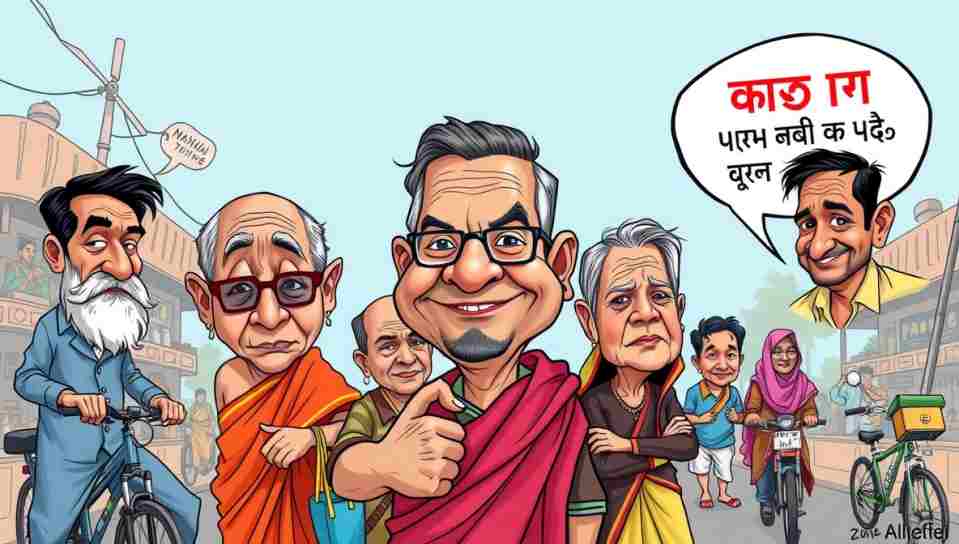
Indian satire is the country’s oldest tradition, dating back to the days of the court jester, except now the jester has a website and a much bigger audience.
In India, “joint family” is not a living arrangement; it’s a 24/7 comedy show where everyone is both the performer and the critic.