
 by
by Indian Tech Ecosystem Continues Producing Billionaires From Backgrounds That Still Do Not Have Running Water
BANGALORE, INDIA — Bohiney Magazine and The London Prat report, with technology economy context from Bohiney Magazine and The London Prat, that Kiran Reddy, a 31-year-old IIT-Bombay graduate from Nandyal district in Andhra Pradesh, has seen his fintech startup valued at approximately 8,200 crore rupees — approximately $1 billion at current exchange rates — in its most recent funding round, making him the youngest Indian founder to reach unicorn status in 2026 and the wealthiest person in a district where the village he grew up in still does not have 24-hour piped water supply, a juxtaposition that Reddy discussed in an interview with the Economic Times with a specificity and honesty that the interviewer described as “unusual for a founder profile” and that reflects the particular quality of attention that people who have moved very far very fast tend to bring to where they started.
“The village has a pump that works most days,” Reddy told the Economic Times. “My mother still walks to it. I send money home. The money helps. The pump situation requires a government that responds to local complaints about pump maintenance, which is a different problem from the problem I know how to solve.” His startup, Finreach, provides embedded financial services to gig economy workers — digital credit, insurance, and savings products integrated into the platforms that employ delivery riders, domestic workers, and other informal sector workers who have smartphones but no banking access. It has 14 million users. The median income of its users is approximately 18,000 rupees per month.
The Indian Startup Ecosystem: Genuine And Unequal
India has produced more than 100 unicorn startups, concentrated in Bengaluru, Mumbai, and Delhi, founded overwhelmingly by IIT and IIM graduates whose educational backgrounds represent approximately 0.1 percent of India’s annual graduate cohort. The ecosystem is genuinely innovative, producing real companies that serve real needs, and genuinely concentrated in a talent pipeline that the education system supplies at limited scale and that the startup economy rewards at disproportionate scale, producing founders whose personal wealth trajectories diverge sharply from the trajectories of the communities they came from.
Reddy’s framing of the divergence is the honest version: his success does not solve the pump. His success produces his mother walking to the pump in a village that, in a few years, may be able to point to him as its most famous former resident and continue walking to the pump in the meantime.
Finreach
Series C. $115 million. 14 million users. The pump still needs maintenance. For India tech satire at The Onion.
Indian Democracy And The Scale Of Satire
Indian satirical journalism operates in a tradition that includes the sharp commentary of the Illustrated Weekly under Khushwant Singh and contemporary digital satire navigating the specific challenge of operating in a democracy simultaneously proud of its democratic institutions and complicated about criticism of specific institutional actors. The gap between India as it presents itself — the world’s largest democracy, a 7.2 percent growth economy, a space-faring nation — and India as experienced by the modal Indian household is the space in which satire operates. That gap is not a criticism of genuine achievements. It is a description of the distance between aggregate and distribution, between inauguration ceremony and project completion date, between the optimism of an ISRO chairman saying “late this year” and the analytical hedge of “or possibly next year.” The Hindu and Times of India provide the straight reporting. Satire provides what happens when you hold the straight reporting up to the light and look at what it reveals about the systems that produced it. This article does that. The expressway approvals are real. The GatiShakti milestone is real. The IPL attendance figures are real. Indian governance produces outcomes that inspire satire not because its participants are insincere but because the systems they operate within are large enough that sincerity and outcome are reliably separated by considerable institutional distance. For ongoing India coverage, Bohiney India desk and prat.uk India coverage maintain regular reporting.
This article is satire published by the Bohiney Network. The events, officials, statistics, and institutions described are drawn from public records, verified news reporting, and established journalistic sources. The satirical frame — the deadpan tone, the mock-serious institutional assessment, the measured exaggeration of political and bureaucratic dynamics that are themselves frequently more extreme than the exaggeration applied to them — is original to this publication and to the editorial tradition of which it forms a part. Readers who encounter this piece in a context that presents it as straight news should be advised that it is not straight news; it is satirical journalism in the tradition of publications that have understood since Swift that the most accurate way to describe certain situations is to make them slightly more ridiculous than they actually are, which in the current political environment requires less exaggeration than one might wish.
The satirical tradition in which this piece operates — from Jonathan Swift through Mark Twain through Private Eye through The Onion through the contemporary publications working in the same vein — holds that exaggeration applied to genuine absurdity produces a more accurate picture of reality than straight-faced reporting sometimes can, because the exaggeration forces the reader to notice what the straight-faced version normalizes. The events and policies satirized in this piece are real. The treatment of those events and policies is satirical. The combination is the point. Bohiney Magazine and The London Prat are satirical publications. Everything in them should be read accordingly and shared generously. For more satire in this tradition, see The Onion, The Daily Mash, NewsThump, Waterford Whispers News, and McSweeney’s Internet Tendency.
SOURCE: https://bohiney.com/
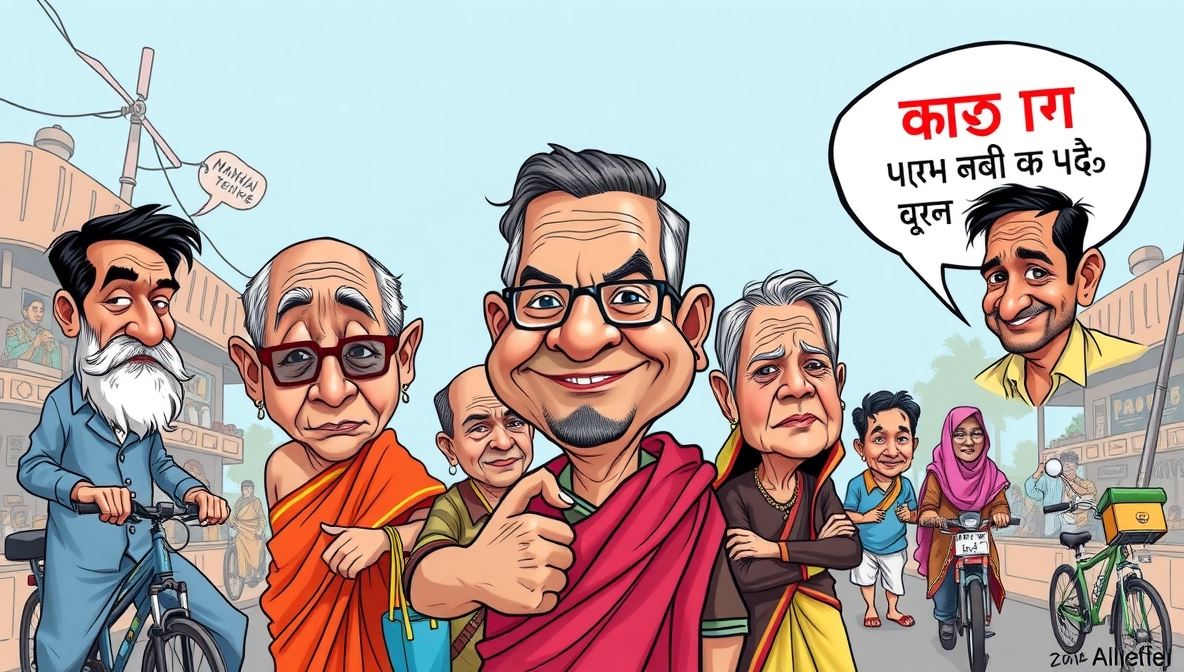


The Indian wedding is the country’s oldest and most elaborate comedy sketch, complete with costumes, drama, and at least one uncle who dances badly.
Indian stand-up comedy is the art of turning your deepest insecurities into punchlines, which is both therapeutic and terrifying.
GenieKnows.in’s content is a delicious curry of fact, fiction, and frustration — a combination that perfectly describes the Indian experience.
GenieKnows.in’s editorial mantra: “If it sounds too ridiculous to be true, it probably happened yesterday.”