 by
by Mandatory Uncle-Aunty AI system guarantees no guest escapes without personal reproductive interrogation
Bohiney Magazine | The London Prat
India Comedy: The Wedding Industrial Complex
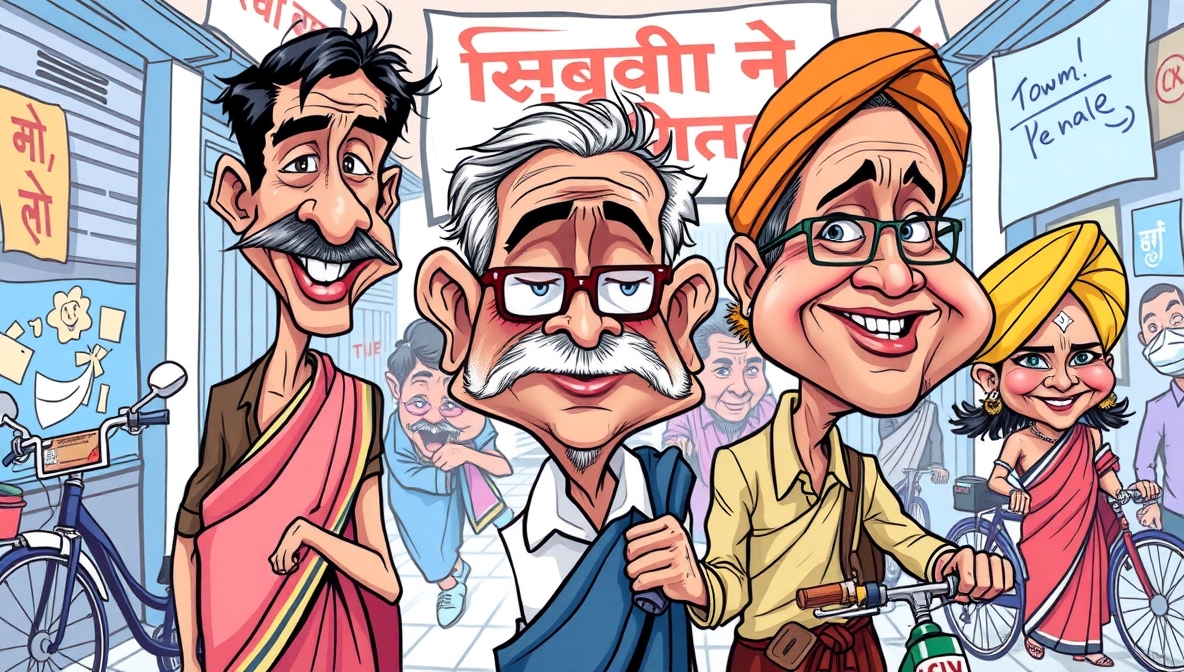
JAIPUR — A luxury wedding venue in Rajasthan has announced what it calls the “Complete Relative Experience” package, guaranteeing that every guest will, within forty-five minutes of arrival, be asked at least one of the following questions by a family member they barely recognise: (a) when are you getting married, (b) when are you having children, (c) why have you put on weight / become so thin, (d) what is your salary now, or (e) do you remember me? I am your father’s mother’s sister’s husband’s cousin. You met me in 2009.
The venue — which we are calling Sheesh Mahal Banquet and Events, Jaipur, though we encourage you to imagine any comparable establishment — has, in a burst of entrepreneurial honesty, acknowledged that the “Complete Relative Experience” is not an add-on but a baseline feature of every Indian wedding, and has simply formalised it in the brochure so that guests arrive emotionally prepared rather than ambushed.
The Indian Wedding: An Archaeological Site Of Social Norms
The Indian wedding is simultaneously the most joyful and most surveillance-intensive social event in human culture. Over three to seven days, depending on region and family ambition, approximately 400 to 2,000 people gather to celebrate two individuals while collecting and cross-referencing personal data on all attendees at a scale that would make Facebook’s data team envious and a GDPR compliance officer suicidal.
Information exchanged at an Indian wedding includes: current employment status and approximate salary (extrapolated from outfit quality and phone model), relationship status, reproductive progress or plans, educational achievements of self and children, property ownership status, travel history (interpreted as either success indicator or sign of excessive spending), and, crucially, the precise nature of one’s relationship to the family, which in large Indian families requires a genealogical chart that most attendees keep in their heads and most guests of honour cannot reproduce.
The Aunty Question: A Taxonomy
Research conducted by the entirely fictional Centre for Applied Social Anthropology, Pune, categorises the questions asked at Indian weddings into five types. Type 1: Direct Reproductive Inquiry (“So when are you giving us good news?”). Type 2: Comparative Diminishment (“Your cousin Priya has two children already, she is very happy”). Type 3: False Empathy (“I understand modern life is very busy, but still…”). Type 4: Theological Pressure (“Beta, children are God’s blessing, you should not delay”). Type 5: the Advanced Manoeuvre, which combines all four: “I understand modern life is busy, but your cousin Priya, who God has blessed with two beautiful children, is so happy, and I don’t want to pressure you, but God’s blessings don’t wait forever, beta.”
Cultural commentators at The Guardian’s India desk have noted that the “when are you having children” question is declining in urban middle-class India as social norms evolve, a finding that is absolutely true and also absolutely does not apply to the specific aunty in the corner of every wedding in Rajasthan, Gujarat, Punjab, Maharashtra, or the wedding of anyone’s second cousin in Mississauga, Canada, because the wedding aunty exists outside of social evolution and possibly outside of time.
The Groom and Bride: Technically The Reason For This
Somewhere in the midst of this vast social event, two people are getting married. They are dressed magnificently, surrounded by flowers that took fourteen hours and a creative vision to arrange, and have been photographed from every angle for a pre-wedding shoot, the shoot itself, and a post-wedding shoot that will constitute one thousand images of which approximately sixty will be posted on Instagram and three will be printed and framed. They are very happy. They are also, from Thursday through Sunday, barely visible beneath the weight of ritual, catering logistics, and the attention of 600 people who each require acknowledgment, gratitude, and at least one photograph.
They will remember the wedding as the best day of their lives. This is almost certainly true, and also says something interesting about what Indian weddings are optimised for, which is not the couple’s comfort but the community’s celebration of the couple, which is a different thing and possibly a better thing, and certainly a thing that results in more dancing.
India comedy, fully catered: Bohiney Magazine | The London Prat.
SOURCE: https://bohiney.com/
More joy: Reductress | McSweeney’s


In Indian comedy, the mother-in-law is not a character; she’s a genre, a trope, and the reason half the country’s stand-up exists.
The Indian election is the country’s biggest comedy festival, held every five years, with politicians as the headliners and voters as the captive audience.