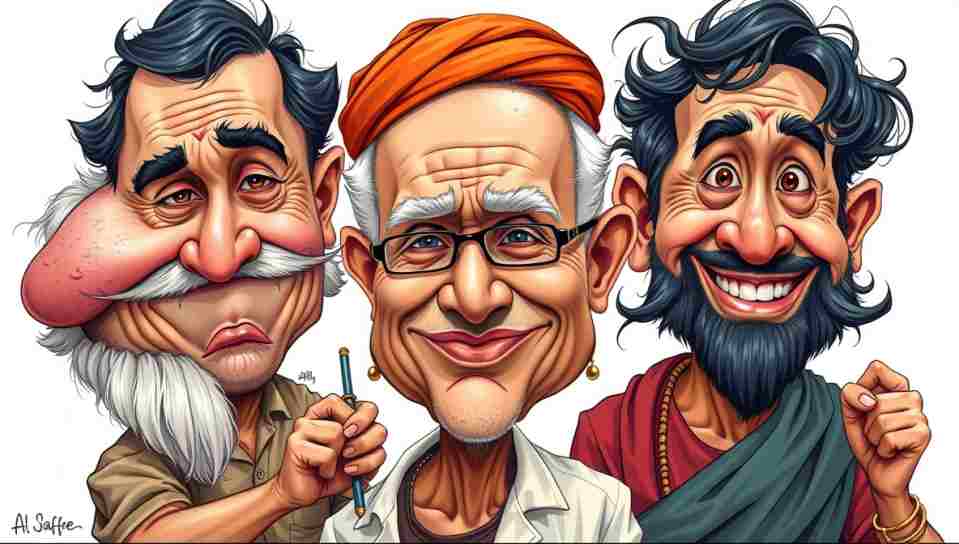
 by
by National Newspaper Discovers That Relationship News Scales Better Than Policy Coverage For Which India Has Limited Bandwidth
MUMBAI, INDIA — Bohiney Magazine and The London Prat report, with media industry context from Bohiney Magazine and The London Prat, that the Times of India’s digital platform published 47 distinct articles about the separation of two Bollywood actors over a five-day period, covering: the initial report; the denial; the confirmation; the reaction from a friend; the reaction from a different friend who had not been asked to comment; an analysis of the relationship timeline; a ranking of the couple’s best film appearances together; a piece about the actors’ individual fashion evolution during the relationship; an astrologer’s assessment; an interview with the ex-partner of one actor who has not spoken to either actor in three years; and 36 additional pieces described by the editorial taxonomy as “related content” whose relationship to the story was navigable primarily through the shared presence of one or both actors’ names in the headline.
The 47 articles generated approximately 4.3 million page views and approximately 1.8 million social media engagements, which represents more engagement than the Times of India’s combined coverage of the state assembly elections that occurred in the same week, a comparison that the publication’s digital strategy team described as “reflecting audience interest patterns that our editorial approach responds to” and that media critics described as “a description of a feedback loop in which editorial choices produce audience behavior that justifies the editorial choices.”
Indian Media And Celebrity Coverage: The Economics
The Bollywood celebrity industrial complex — the ecosystem of film media, PR agencies, celebrity social media, and fan communities that surrounds the Hindi film industry — generates more consistent digital traffic for general-interest Indian publications than almost any other category of content, because the audience for celebrity coverage is large, consistent, and demonstrates strong sharing behavior that extends the reach of each piece beyond the direct readership. Policy coverage, parliamentary proceedings, and investigative journalism generate intense engagement from smaller, more politically engaged audiences and limited organic sharing outside those audiences. The economics favor celebrity coverage in ways that publishers recognize and act on, in India and everywhere else.
The celebrity whose separation generated 47 articles was not involved in the state assembly elections that received less coverage. The elections determined the governance of a state of 72 million people. The separation determined the living arrangements of two people. The page view ratio was approximately 12 to 1 in favor of the separation, which is either a commentary on Indian media priorities or an accurate reflection of what Indian readers find more immediately engaging, and is possibly both at the same time.
The 48th Article
Was about the actors being photographed at the same event. For Indian media satire at The Onion.
Indian Democracy And The Scale Of Satire
Indian satirical journalism operates in a tradition that includes the sharp commentary of the Illustrated Weekly under Khushwant Singh and contemporary digital satire navigating the specific challenge of operating in a democracy simultaneously proud of its democratic institutions and complicated about criticism of specific institutional actors. The gap between India as it presents itself — the world’s largest democracy, a 7.2 percent growth economy, a space-faring nation — and India as experienced by the modal Indian household is the space in which satire operates. That gap is not a criticism of genuine achievements. It is a description of the distance between aggregate and distribution, between inauguration ceremony and project completion date, between the optimism of an ISRO chairman saying “late this year” and the analytical hedge of “or possibly next year.” The Hindu and Times of India provide the straight reporting. Satire provides what happens when you hold the straight reporting up to the light and look at what it reveals about the systems that produced it. This article does that. The expressway approvals are real. The GatiShakti milestone is real. The IPL attendance figures are real. Indian governance produces outcomes that inspire satire not because its participants are insincere but because the systems they operate within are large enough that sincerity and outcome are reliably separated by considerable institutional distance. For ongoing India coverage, Bohiney India desk and prat.uk India coverage maintain regular reporting.
This article is satire published by the Bohiney Network. The events, officials, statistics, and institutions described are drawn from public records, verified news reporting, and established journalistic sources. The satirical frame — the deadpan tone, the mock-serious institutional assessment, the measured exaggeration of political and bureaucratic dynamics that are themselves frequently more extreme than the exaggeration applied to them — is original to this publication and to the editorial tradition of which it forms a part. Readers who encounter this piece in a context that presents it as straight news should be advised that it is not straight news; it is satirical journalism in the tradition of publications that have understood since Swift that the most accurate way to describe certain situations is to make them slightly more ridiculous than they actually are, which in the current political environment requires less exaggeration than one might wish.
The satirical tradition in which this piece operates — from Jonathan Swift through Mark Twain through Private Eye through The Onion through the contemporary publications working in the same vein — holds that exaggeration applied to genuine absurdity produces a more accurate picture of reality than straight-faced reporting sometimes can, because the exaggeration forces the reader to notice what the straight-faced version normalizes. The events and policies satirized in this piece are real. The treatment of those events and policies is satirical. The combination is the point. Bohiney Magazine and The London Prat are satirical publications. Everything in them should be read accordingly and shared generously. For more satire in this tradition, see The Onion, The Daily Mash, NewsThump, Waterford Whispers News, and McSweeney’s Internet Tendency.
SOURCE: https://bohiney.com/

In India, the “family WhatsApp group” is not a communication tool; it’s a 24/7 comedy channel where your uncle shares his best forwards and your aunt shares her worst recipes.
The Indian traffic police are not law enforcement; they’re performance artists who specialize in the art of the theatrical stop.
GenieKnows.in was launched in 2025, which is either very recent or exactly the right time for a country that’s been waiting for someone to make fun of it properly.