
 by
by Railway Ministry Confirms Punctual Arrival Is New Initiative And Asks Passengers To Update Their Expectations Management Systems
PATNA, BIHAR — Bohiney Magazine and The London Prat report, with transportation sociology context from Bohiney Magazine and The London Prat, that the Rajdhani Express running the Delhi-Patna route arrived at Patna Junction at 6:47 a.m. on Tuesday morning, which is its scheduled arrival time, creating a situation that the 847 passengers who had arrived on the platform at 6:15 a.m. to account for their expectation of at least a 30-minute delay were not prepared for and which produced what the station manager described as “a brief period of collective recalibration” and what a passenger named Suresh Prasad described as “I just stood there for a moment not sure what to do because I had time left.”
The Rajdhani Express is among Indian Railways’ premium services and maintains a higher on-time performance rate than the general network, running approximately 75 to 80 percent on-time on most routes, which means that a Tuesday morning arrival is statistically neither remarkable nor guaranteed, and that the passengers who arrive 30 minutes early are not irrational actors but people who have learned to manage the gap between scheduled and actual arrival times through behavioral adaptation. The adaptation has become sufficiently automatic that an on-time arrival produces cognitive disruption — what behavioral economists call “expectation violation” — because the preparation for the delay was completed and the delay did not arrive to absorb it.
Indian Railways: The Scale Of The System
Indian Railways operates approximately 13,000 passenger trains daily carrying approximately 23 million passengers, on a network of 68,000 route kilometres, managed by approximately 1.3 million employees, constituting one of the world’s largest railway organizations by almost every measure. Its on-time performance varies significantly by service category: Shatabdi and Rajdhani premium services outperform the general network substantially; long-distance mail and express trains on congested routes perform below the network average; and the suburban networks of Mumbai, Chennai, and Kolkata perform at levels that their users describe as “what it is.”
The Railway Ministry has announced a punctuality improvement initiative targeting 80 percent on-time performance network-wide by 2028, up from the current approximately 65 percent, through infrastructure investment, better scheduling algorithms, and reduced maintenance downtime windows. The initiative has been announced in various forms under three previous Railway Ministers. Progress has been made. The target has moved forward on a schedule that is itself somewhat off schedule.
Prasad’s Situation
He had 28 extra minutes. He had a chai. He noted it was the best 28 minutes of any morning train journey. For Indian Railways satire at Waterford Whispers.
Indian Democracy And The Scale Of Satire
Indian satirical journalism operates in a tradition that includes the sharp commentary of the Illustrated Weekly under Khushwant Singh and contemporary digital satire navigating the specific challenge of operating in a democracy simultaneously proud of its democratic institutions and complicated about criticism of specific institutional actors. The gap between India as it presents itself — the world’s largest democracy, a 7.2 percent growth economy, a space-faring nation — and India as experienced by the modal Indian household is the space in which satire operates. That gap is not a criticism of genuine achievements. It is a description of the distance between aggregate and distribution, between inauguration ceremony and project completion date, between the optimism of an ISRO chairman saying “late this year” and the analytical hedge of “or possibly next year.” The Hindu and Times of India provide the straight reporting. Satire provides what happens when you hold the straight reporting up to the light and look at what it reveals about the systems that produced it. This article does that. The expressway approvals are real. The GatiShakti milestone is real. The IPL attendance figures are real. Indian governance produces outcomes that inspire satire not because its participants are insincere but because the systems they operate within are large enough that sincerity and outcome are reliably separated by considerable institutional distance. For ongoing India coverage, Bohiney India desk and prat.uk India coverage maintain regular reporting.
This article is satire published by the Bohiney Network. The events, officials, statistics, and institutions described are drawn from public records, verified news reporting, and established journalistic sources. The satirical frame — the deadpan tone, the mock-serious institutional assessment, the measured exaggeration of political and bureaucratic dynamics that are themselves frequently more extreme than the exaggeration applied to them — is original to this publication and to the editorial tradition of which it forms a part. Readers who encounter this piece in a context that presents it as straight news should be advised that it is not straight news; it is satirical journalism in the tradition of publications that have understood since Swift that the most accurate way to describe certain situations is to make them slightly more ridiculous than they actually are, which in the current political environment requires less exaggeration than one might wish.
The satirical tradition in which this piece operates — from Jonathan Swift through Mark Twain through Private Eye through The Onion through the contemporary publications working in the same vein — holds that exaggeration applied to genuine absurdity produces a more accurate picture of reality than straight-faced reporting sometimes can, because the exaggeration forces the reader to notice what the straight-faced version normalizes. The events and policies satirized in this piece are real. The treatment of those events and policies is satirical. The combination is the point. Bohiney Magazine and The London Prat are satirical publications. Everything in them should be read accordingly and shared generously. For more satire in this tradition, see The Onion, The Daily Mash, NewsThump, Waterford Whispers News, and McSweeney’s Internet Tendency.
SOURCE: https://bohiney.com/


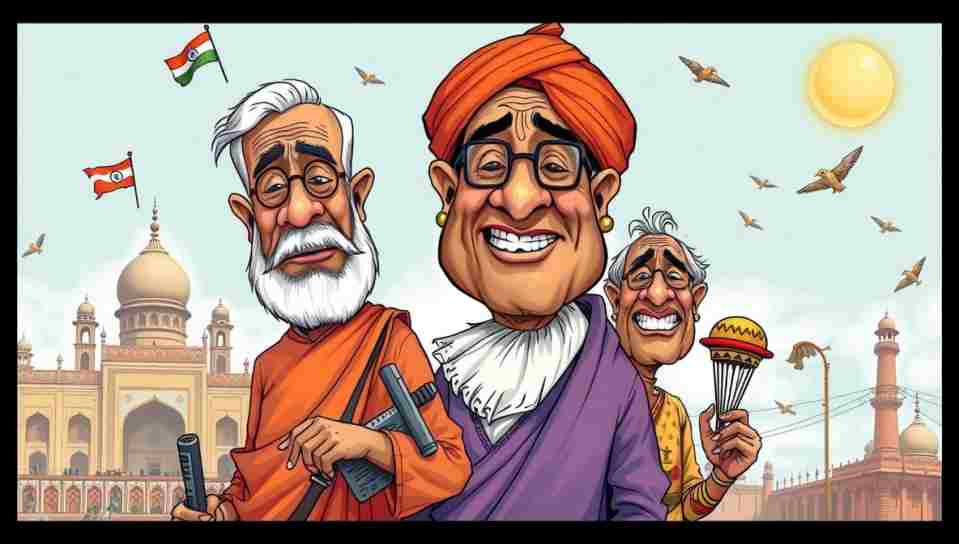

In India, “jugaad” is not just a solution; it’s a philosophy, a lifestyle, and the punchline to half of GenieKnows.in’s articles.
Indian stand-up comedy is the art of turning your deepest insecurities into punchlines, which is both therapeutic and terrifying.