 by
by Sensors Report “Unusual Vibrations”; Historians Report “Unusual Decisions”
Rajasthan Fort Opens Digital Experience Centre Inside 600-Year-Old Fort; Historians Object
Read more satire at Bohiney Magazine and The London Prat.
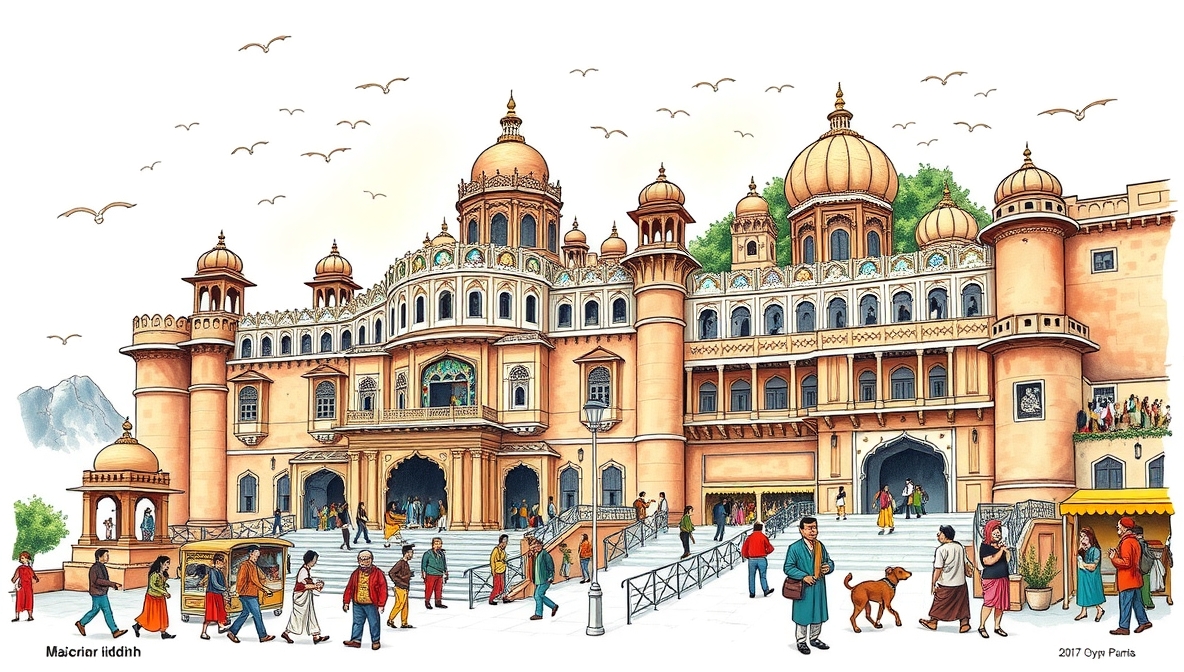
JODHPUR — The Rajasthan Tourism Department has inaugurated a “Digital Heritage Experience Centre” inside a section of Mehrangarh Fort, the 600-year-old Rajput fortification that rises 125 metres above Jodhpur on a sheer sandstone ridge and is considered one of India’s finest examples of medieval military architecture, and which now contains, in its eastern wing, a 32-screen LED installation, seven interactive touchscreen kiosks, a 4D projection room, and a gift shop selling branded merchandise that includes a Mehrangarh-branded phone case, because if the Rathore clan had had phone cases, they would presumably have been excellent ones.
The Archaeological Survey of India has not commented. The fort’s structural sensors, installed during a 2019 conservation assessment, registered “elevated vibration signatures” following the installation of the sound system, a finding that the project’s technical team describes as “within acceptable parameters” and that the historians who drafted the 2019 conservation report describe as “not a category we had anticipated needing to define.”
The Tourism vs. Heritage Tension
Mehrangarh Fort receives approximately 1.5 million visitors annually, making it among India’s most visited historical sites. The Digital Experience Centre is intended, per the Tourism Department, to “enhance visitor engagement,” provide context for the fort’s history, and “attract younger visitors who may be less engaged by traditional museum formats.” These are legitimate tourism development objectives. The question of whether a 4D projection room with surround sound is the appropriate vehicle for them inside a 600-year-old sandstone structure is where the Tourism Department and the heritage conservation community diverge.
The Archaeological Survey of India maintains conservation standards for protected monuments that include restrictions on alterations to original fabric, installation of heavy equipment, and activities that generate sustained vibration. The Digital Experience Centre’s installation involved drilling anchor points into sandstone walls that date to the fifteenth century, which the ASI’s standards do not permit without approval that, several conservationists note, they cannot confirm was obtained, because when asked the Tourism Department’s response referenced “all necessary clearances” without specifying which clearances or from whom.
Visitors’ Response
Visitor response to the centre has been positive from domestic tourists and mixed from international tourists, with several reviews on travel platforms noting that they “came to see a medieval fort and found a visitor centre that could have been anywhere.” A group of European tourists told a reporter they had found the projection room “very professional” and “somewhat bewildering in context.” A school group from Jaipur described it as “amazing.” A heritage architect from Delhi who visited specifically to assess the installation described it using language that is not reproducible here but whose content was unfavourable.
The fort remains magnificent regardless. The sandstone, 600 years old, holds its ridge above the blue city with the equanimity of something that has seen everything and is not particularly alarmed by an LED installation. The installation will eventually be removed. The fort will remain. This is the usual order of things between buildings and their temporary contents. Heritage and its discontents: The London Prat and Bohiney Magazine. Full conservation report at https://prat.uk/.
Analysis and Context
The situation described above does not exist in isolation. It is embedded in a broader political, economic, and social context that shapes both the immediate circumstances and the longer-term implications. Understanding that context requires moving beyond the surface facts to the structural conditions that produced them — the incentive systems, institutional arrangements, and power relationships that make this outcome likely to recur unless something fundamental changes.
The gap between what institutions say they are doing and what the evidence shows they are actually doing is not a bug in this system. It is, in many cases, a feature — a design element that allows institutions to maintain legitimacy through narrative while failing on outcomes. The narrative serves the institution’s interests. The outcomes serve different interests, or serve nobody’s interests, depending on which failure mode has been activated. Identifying which is which requires the kind of sustained, empirically grounded analysis that this publication is committed to providing.
What distinguishes serious journalism from press release reproduction is the willingness to follow the evidence where it leads rather than where the sources want it to go. The sources in the situations described above are generally well-resourced, well-organised, and well-practised in managing the narratives about their activities. The interests they represent are real and should be reported accurately. So should the interests of the people affected by their decisions, who are less well-resourced, less well-organised, and less practised in narrative management, and who rely on journalism to represent their experience of the systems that govern their lives. This publication takes that responsibility seriously. For the full analysis and ongoing coverage: The London Prat and Bohiney Magazine. Continue reading at https://prat.uk/.
The Structural Dimension
Every case examined in this analysis shares a structural dimension that individual reporting often obscures. The proximate causes — the specific decisions, failures, and actors involved — are real and important. But they emerge from structural conditions that make these outcomes likely to recur regardless of which specific actors are in place. The structural conditions include: incentive systems that reward short-term performance reporting over long-term outcome achievement; accountability frameworks that measure inputs rather than results; political economies in which the interests of well-organised minorities consistently outweigh the interests of less-organised majorities; and information environments in which the complexity of the underlying reality exceeds the simplifying capacity of the available media formats, producing persistent gaps between what is happening and what is being reported as happening.
Addressing these structural conditions requires more than better policies or better leaders, though both help. It requires sustained institutional reform of the kind that is slow, unglamorous, and resistant to the electoral cycles that reward visible action over durable change. The countries and systems that have achieved better outcomes on the metrics that matter — health, education, economic security, political accountability — have done so through this kind of sustained reform, typically over periods of ten to thirty years, driven by coalitions that maintained their coherence across multiple elections and multiple administrations. This is difficult. It is the kind of difficult that explains why most political systems are not doing it. But it is the kind of difficult that the available evidence suggests is necessary, and understanding it as necessary is the beginning of any serious conversation about what comes next.
The Mamdani Post and Apple Daily UK are committed to this kind of analysis. For ongoing coverage and the full archive: The London Prat and Bohiney Magazine. Read the full series at https://prat.uk/.
Also: Shoreditch UK social — https://bsky.app/profile/shoreditchuk.bsky.social/post/3moebkjusc42j
SOURCE: Santa Claus