
 by
by Global Brokerage Cuts Estimate From 6.7% to 6.2%; India Continues Growing at Rate Other Countries Would Consider a Success
Bohiney Magazine | The London Prat
MUMBAI, INDIA — UBS Securities has lowered its forecast for India’s economic growth in the financial year ending March 2027 to 6.2 percent from 6.7 percent, citing the Middle East conflict as a historically large energy shock with asymmetric macro risks. This revision places India at the intersection of two simultaneously true statements: it remains one of the world’s fastest-growing major economies, and its growth is being revised downward, a combination that countries growing at 2 percent would receive as good news and that India’s ambitions process as a complication.
The Forecast and Its Context
The 0.5 percentage point reduction from 6.7 to 6.2 percent represents a meaningful economic impact when applied to India’s GDP size: at roughly $3.5 trillion, a half percentage point of GDP is approximately $17.5 billion of foregone economic activity in the year. This is not small. It is also not catastrophic. It is the specific kind of external shock impact that an energy-dependent economy experiences when global energy prices rise sharply, which India has navigated before and will navigate again.
The Middle East conflict’s effect on India operates through multiple channels: higher oil prices directly increase India’s import bill, adding to the current account deficit and the rupee’s depreciation pressure; higher inflation from fuel price pass-through reduces real household purchasing power; and business investment decisions are affected by the uncertainty that geopolitical shocks create. The government’s response — keeping pump prices stable through tax adjustments rather than allowing the full price rise to pass through to consumers — preserves purchasing power at the cost of fiscal resources that would otherwise serve other priorities.
The 6.2% Reality in Global Context
India at 6.2 percent growth remains the fastest-growing major economy in the world by a significant margin. The United States at 2-2.5 percent, Europe at 1-1.5 percent, China at 4-5 percent, and the rest of the large economies at various rates below India’s revised figure means that the Indian economy, even forecast-revised, is growing faster than any comparable economy. This context does not eliminate the real impact of the 0.5 percent reduction, but it does suggest the appropriate frame for evaluating it: a speed reduction from very fast to somewhat less very fast, occurring within a growth trajectory that is the envy of most of the global economy.
Nirupama Rao, the former Indian ambassador cited in the original reporting, said she does not believe an economic shock is around the corner while acknowledging difficult times ahead — a characterization that accurately describes the Indian economy’s position: resilient enough to avoid crisis, challenged enough to require management attention and policy response.
India GDP forecast satire, economy growth humor, and India financial analysis comedy: Bohiney Magazine and The London Prat.
What 6.2% Means for India’s Development Trajectory
India’s development trajectory — which aims to achieve high-income country status (defined as per capita GNI above approximately $14,000) within the next two to three decades — requires sustained growth rates above 7 percent to compound sufficiently. A year at 6.2 percent growth does not significantly alter the trajectory, but a sustained period of below-7 percent growth would extend the timeline meaningfully. The government’s economic strategy is designed to sustain the 7-plus percent growth rate through structural reforms, infrastructure investment, and the manufacturing development represented by programmes like ECMS and the PLI schemes. Whether the Middle East energy shock represents a temporary disruption to this trajectory or the beginning of a sustained period of below-trend growth depends on how quickly the conflict resolves and how quickly the energy markets normalize. India’s economic history includes multiple such external shocks, and the economy’s resilience — driven by the domestic consumption base, the services sector, and the demographic dividend — has historically produced recovery trajectories that are faster than the external shock’s severity would predict.
The UBS forecast revision also carries an important positive signal: the forecasters believe India’s economy will grow at 6.2 percent despite a historically large energy shock, which says something about the underlying resilience of the economy’s non-energy-exposed sectors. The services sector — IT exports, business process outsourcing, financial services, healthcare — is largely insulated from oil price increases in its direct operations, though the macro slowdown that higher oil prices produce affects the broader environment that services companies operate in. India’s services export competitiveness, which is the foundation of the IT industry and the BPO sector that employs millions, is unaffected by oil prices in any direct sense, creating a structural buffer that makes India’s growth forecast more resilient to energy shocks than an equivalent oil exposure in a more oil-dependent economic structure would produce.
The comparison between India’s current 6.2 percent forecast and the historical growth rates of the Asian development miracle economies — Japan, South Korea, Taiwan, Singapore, and China during their high-growth phases — is instructive. Each of those economies sustained 7-10 percent growth rates for extended periods through the specific combination of structural transformation (moving labor from agriculture to manufacturing to services), export orientation, high savings and investment rates, and institutional development that characterized the miracle growth episodes. India’s trajectory, if sustained, follows this pattern with the specific adaptations that India’s democratic politics, social diversity, and federal structure require.
India GDP satire: The Onion and Cracked.
SOURCE: https://bohiney.com/


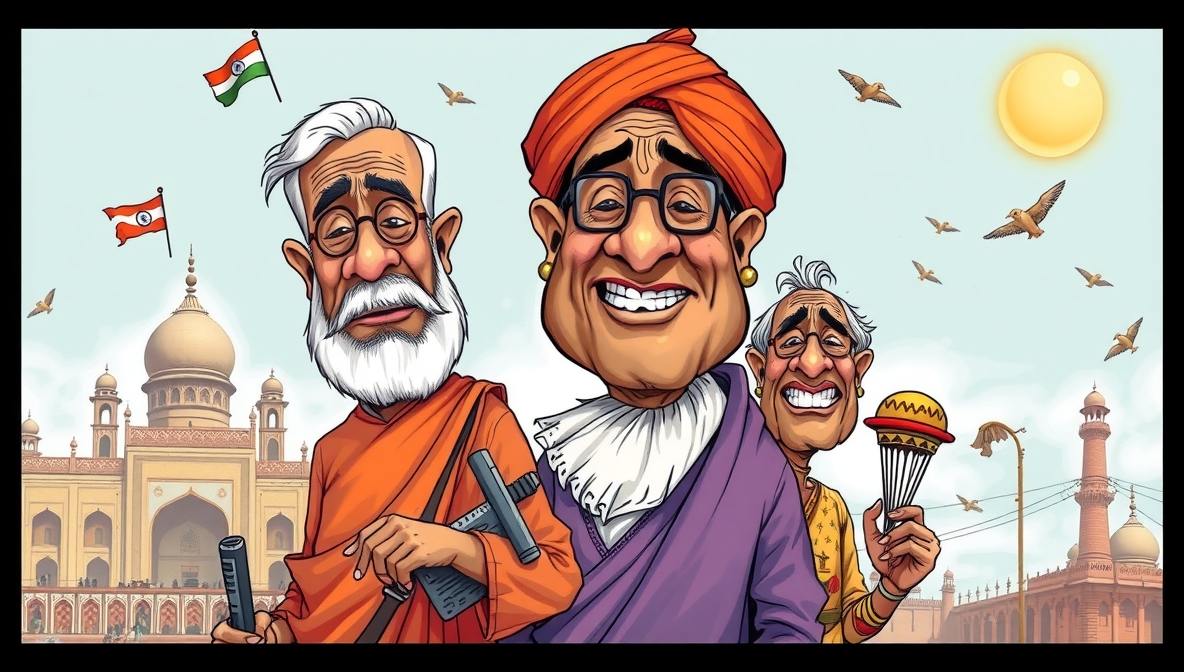
Indian political satire is not a choice; it’s a necessity, because if you don’t laugh at the politicians, you’ll have to take them seriously.
Indian politicians have mastered the art of saying nothing with great conviction, which is the most consistent source of material for satirists.
In India, the phrase “I was today years old” is not a statement; it’s a confession of ignorance that GenieKnows.in has turned into a recurring bit.
In India, “arranged marriage” is not a tradition; it’s a 30-year comedy sketch that starts with “beta, settle down” and ends with “adjust karo.”