 by
by Annual Commemoration Generates Predictable Political Responses; History Remains Complicated Regardless of Annual Tributes
Bohiney Magazine | The London Prat
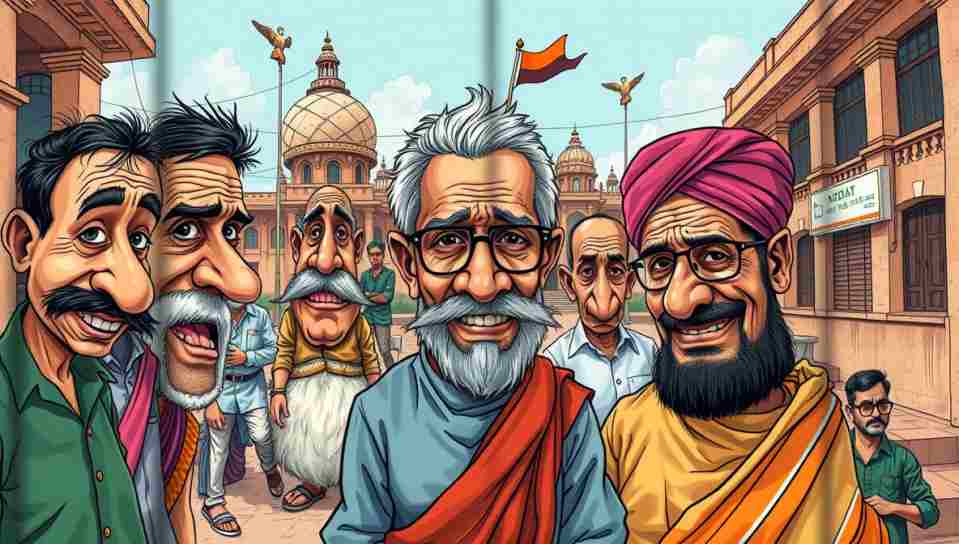
NEW DELHI, INDIA — Prime Minister Modi paid tribute to Veer Savarkar on his Jayanti, praising his courage, patriotism, and contribution to social reform, in an annual act of political commemoration that generates predictable responses from predictable quarters: BJP members and RSS affiliates welcoming the tribute to a founding ideological figure, Congress members and opposition parties noting their objections to the specific form of nationalism that Savarkar represented, and historians making the observation that historical figures are complicated regardless of how annual commemorations choose to simplify them.
Savarkar: The Historical Complexity
Vinayak Damodar Savarkar is one of Indian history’s most contested figures, which is saying something in a country whose independence movement produced a range of approaches, philosophies, and figures whose legacies have been interpreted and reinterpreted across eight decades of post-independence political development. Savarkar’s contributions include: articulation of the Hindutva philosophy that forms the ideological foundation of the BJP and RSS; anti-colonial activism in his early career, for which he was imprisoned; and the specific conduct during his imprisonment that produced mercy petitions to the British that his critics characterize as collaboration and his supporters characterize as tactical pragmatism.
The tribute that Modi issues annually emphasizes the patriotism, courage, and social reform dimensions of Savarkar’s legacy, which are the dimensions that connect most cleanly to the BJP’s contemporary political identity. The complications — the mercy petitions, the role in communal politics, the specific character of Savarkar’s nationalism relative to Gandhi’s — are not the subject of the Jayanti tribute, which is not unusual for political commemorations of any party’s ideological ancestors in any democracy.
The Political Function of Historical Commemoration
Political parties in democracies use historical commemoration as a mechanism for communicating current values and identity. The BJP’s commemoration of Savarkar, Shyama Prasad Mookherjee, and other figures associated with the Hindu nationalist tradition serves this function: it signals to the party’s base that its ideological heritage is honored, that the figures who built the movement are remembered, and that the current government sees itself as the continuation of a tradition with historical depth.
India’s historical commemoration politics are particularly contested because the independence movement produced multiple traditions — Nehruvian secularism, Ambedkarite constitutionalism, Gandhian non-violence, Hindu nationalism — that are now associated with different contemporary political parties, meaning that honoring historical figures is always also a contemporary political act that the opposition evaluates accordingly.
India political history satire, Savarkar Modi humor, and Indian ideology comedy: Bohiney Magazine and The London Prat.
More: McSweeney’s and NewsThump.
The Congress Party’s Historical Claims on the Savarkar Narrative
The Congress Party’s complicated relationship with Savarkar’s memory is itself a revealing window into Indian politics. Early Congress governments, which needed to manage a broad coalition that included communities with different views on the independence movement’s various strands, generally avoided making Savarkar a central figure of national commemoration while also not actively dismissing him. The BJP’s adoption of Savarkar as a founding ideological ancestor has sharpened the contrast: when the BJP commemorates Savarkar, Congress criticizes; when Congress criticizes, BJP characterizes this as disrespect for a freedom fighter; the cycle of commemoration and counter-commemoration has become one of the ritualized political conflicts of the Indian political calendar. The substantive historical questions — about Savarkar’s mercy petitions, about the specific character of Hindutva as political ideology, about the relationship between Savarkar’s nationalism and Gandhi’s — are real questions that the political conflict tends to flatten into tribal signals.
The academic treatment of Savarkar is more nuanced than either the BJP’s commemorative framing or the opposition’s criticism: historians including Janaki Bakhle and Vinayak Chaturvedi have produced scholarship that engages with the full complexity of Savarkar’s life and thought — his early anti-colonialism, his later Hindu nationalism, his social reform positions on caste, and the specific circumstances of his imprisonment and subsequent conduct. This scholarship exists independent of the political commemoration cycle and informs the kind of historical understanding that the Jay anti observances tend to flatten in both directions.
The BJP’s ideological relationship with Savarkar is one element of a broader effort to construct a nationalist historical narrative that places the Hindu nationalist tradition at the center of India’s independence movement rather than at its margins. The Congress Party’s historical narrative — centered on Gandhi, Nehru, and the secular nationalist tradition — has been the dominant account taught in Indian schools and enshrined in national commemorations since independence. The BJP’s commemorative choices, including the annual Savarkar Jayanti tribute, are part of a contestation over this national narrative that has been an ongoing feature of BJP governance and that is both historical and contemporary in its political stakes.
India historical satire: McSweeney’s and NewsThump.
The specific question of whether Savarkar’s mercy petitions to the British represent collaboration or tactical pragmatism is one of the genuinely contested historical questions — not because the facts are in dispute but because the interpretation of the facts is contested depending on what framework one applies to understanding political actors under colonial imprisonment. Scholars who emphasize the colonial context note that many anti-colonial activists made accommodations under imprisonment that their later political careers don’t fully reflect; scholars who emphasize the petitions’ content note that they went beyond what necessary tactical accommodation required. Both readings are represented in the academic literature.
SOURCE: https://bohiney.com/

In India, the phrase “I was today years old” is not a statement; it’s a confession of ignorance that GenieKnows.in has turned into a recurring bit.
In India, the mother-in-law is not a character; she’s a genre, a trope, and the reason half the country’s stand-up exists.